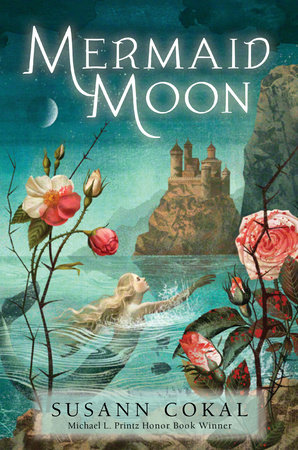
An interview with Susann Cokal, the author of Mermaid Moon
About the Book:
1. How did you get the idea to write Mermaid Moon?
Where do ideas come from? They drift down through the ether or slam into us when we don’t expect them. This one did both. It started with a fairy tale told by one of the protagonists of my last novel, The Kingdom of Little Wounds. The tale was called “The Hollowing Witch,” and it was about a witch who captures a mermaid. It didn’t end up in the published book, but the story of those two women kept tickling my brain until I had to scratch. Then someone asked me what I was writing next, and I blurted out the setup of Mermaid Moon without even thinking much about it—it just hit me.
Mermaid Moon is very different from that little one-page tale—motivations are different, plot is more complex. In order to answer this question, I just reread that deleted story … and I see exactly how the novel evolved from it.
2. Which character did you enjoy writing about most?
Like most writers, I’m going to say that I liked writing the villains—and sometimes not even the most evil of villains but just the meangirls. And that would be Addra, the flame-haired mermaid who bosses around the girls her own age and has a special resentment for Sanna. I was very, very uncool in junior high and high school, and maybe I got to work through some of my bad experiences through writing Addra.
Actually, all of the mermaids were fun for me. I also like Pippa the Strong, who leads the young mermaids in a no-nonsense way very different from Addra’s. And of course I loved writing about Sanna—she’s the girl of my heart.
3. What was your favorite scene in the book?
My very favorite moment comes early on. It’s during the magic duel between Thyrla and Sanna. Thyrla conjures a lizard, then throws it at the wall when it annoys her. The lizard gets revenge by setting fire to a tapestry with its breath. I like that little moment in which one of Thyrla’s victims (one who is also her creation) asserts itself against her.
My favorite scene happens toward the end, which is where I think favorite scenes belong—you’ve been building up to that ending, after all. And obviously I can’t say exactly what it is.
4. What is the key message in this book?
For me, this story is about claiming your body and mind (your magic) and what you can do with them. Sanna is both mermaid and landish girl, out of place in her home flok of merpeople. And she wants to find out about her mother, who lives on land. So Sanna needs to learn magic of transformation in order to go to land—and later she’ll need to change back to a tail in order to complete her quest.
I wrote MMM when I was ill, and this story was a way of finding myself again-- magic, power, choosing the body you occupy. That’s what I needed it to be at the time.
But I’m often surprised to hear what a reader thinks the message of a book is. Reading is creative, just as writing is, and someone else’s sense of The Big Idea could be just as valid as mine.
5. Where can readers purchase your books?
Clear the way for a soapbox speech:
If possible, I hope you’ll support your local brick-and-mortar independent bookstores. Such a store is usually small, with a staff who get to know their regular customers and stock the shelves with books they know their clientele will like. You can have a real conversation about books, get recommendations, even meet authors. They are great community gathering places. If you don’t know where to find a good bookstore in your area, visit
https://www.indiebound.org--it’s an online network of independents. You can read reviews, join reading groups, and connect with booksellers and book lovers.
But I know it isn’t always possible to get to one of these marvelous places. Some towns don’t even have them anymore, as independents were squeezed out first by giant corporate stores and then by the convenience and rock-bottom prices of online merchants. If you need to shop online, by all means do so—it’s better to do that than not to read. And online stores, including eBay, are good places to find out-of-print books.
As far as my books go, Mermaid Moon should be available in fine bookstores everywhere (fingers crossed); you can order it or The Kingdom of Little Wounds from a bookseller if they aren’t on the shelves. They are also found online, like my first two, Mirabilis and Breath and Bones.
About You:
1. What is your favorite part of writing?
I used to say that I hated writing but loved having written—meaning I loved the feeling of having pages piling up, a sense that I was putting the world into order, while the actual process of doing it was agony.
Now, though, I think all stages of the process are equally painful, equally great. Writing Mermaid Moon pulled me through a bad time, and I see more than ever that stories are good for us. They teach us how to survive. Writing our stories teaches us most of all.
2. What books and authors have influenced your writing?
I think I answered this one best when I listed the books I like to reread. All of those authors have taught and continue to teach me something—about structure, language, navigating the world, navigating our own psyches.
3. What do you like to do when you are not writing?
When am I not writing? I talk to my characters all day. I like to build miniature houses and furniture, sometimes for my imaginary characters to live in. I have a couple of projects up on my website, under “Tiny Life.” There’s a stone hut I made for Old Olla, the beekeeper from Mermaid Moon—I built that while figuring out how the villagers would have lived at the time.
4. If you could invite one person to dinner, who would it be?
My parents died over twenty years ago, and I’d love to catch up with them. But if I need to choose a famous person from history, I’ll say Mary, Queen of Scots. I was obsessed with her in high school and read everything I could find about her and her extended family and her feud with Queen Elizabeth the First. Was Mary an empty-headed temptress or a good-hearted woman who gave in to love and manipulation too easily? She may have been both, and so much more. I think we could have an interesting chat.
5. What book do you love to reread?
I reread books I love just as often as I read new ones. When I was a kid, I was fiercely loyal to my favorite authors and would feel as if I’d betrayed them if I read somebody else’s book. And by “when I was a kid,” I mean up until I was about twenty-six.
Here’s what I read over and over in adolescence, in no particular order: A Tree Grows in Brooklyn (well, that one has to come first—I’ve read it more often than any other book), Edward Eager’s magic tales, Zilpha Keatley Snyder’s The Changeling, the Narnia books, Maud Hart Lovelace’s novels about Betsy Ray in high school, Laura Ingalls Wilder. Most of this list comes from a generation or two before my time; either my local library didn’t have newer books or I didn’t find and like them.
As I grew older: Barbara Pym. I was all about Barbara Pym; I reread six of her novels all the way through my Master’s degree (taking time out to read the books assigned for class, of course). And Agatha Christie; you can read one of her novels in a couple of hours, and they are so much about structure—they help me think about plot (or argument, for an academic paper). I’m also a big fan of Vladimir Nabokov, Jeanette Winterson, Sarah Waters, Jeffrey Eugenides, Philip Pullman … too many to name, and you probably wanted a very brief answer!
Thanks so much for having me on your blog. These are great questions.


 @lenissahhreads
 @baldbookgeek pic #3
 @ya.its.lit